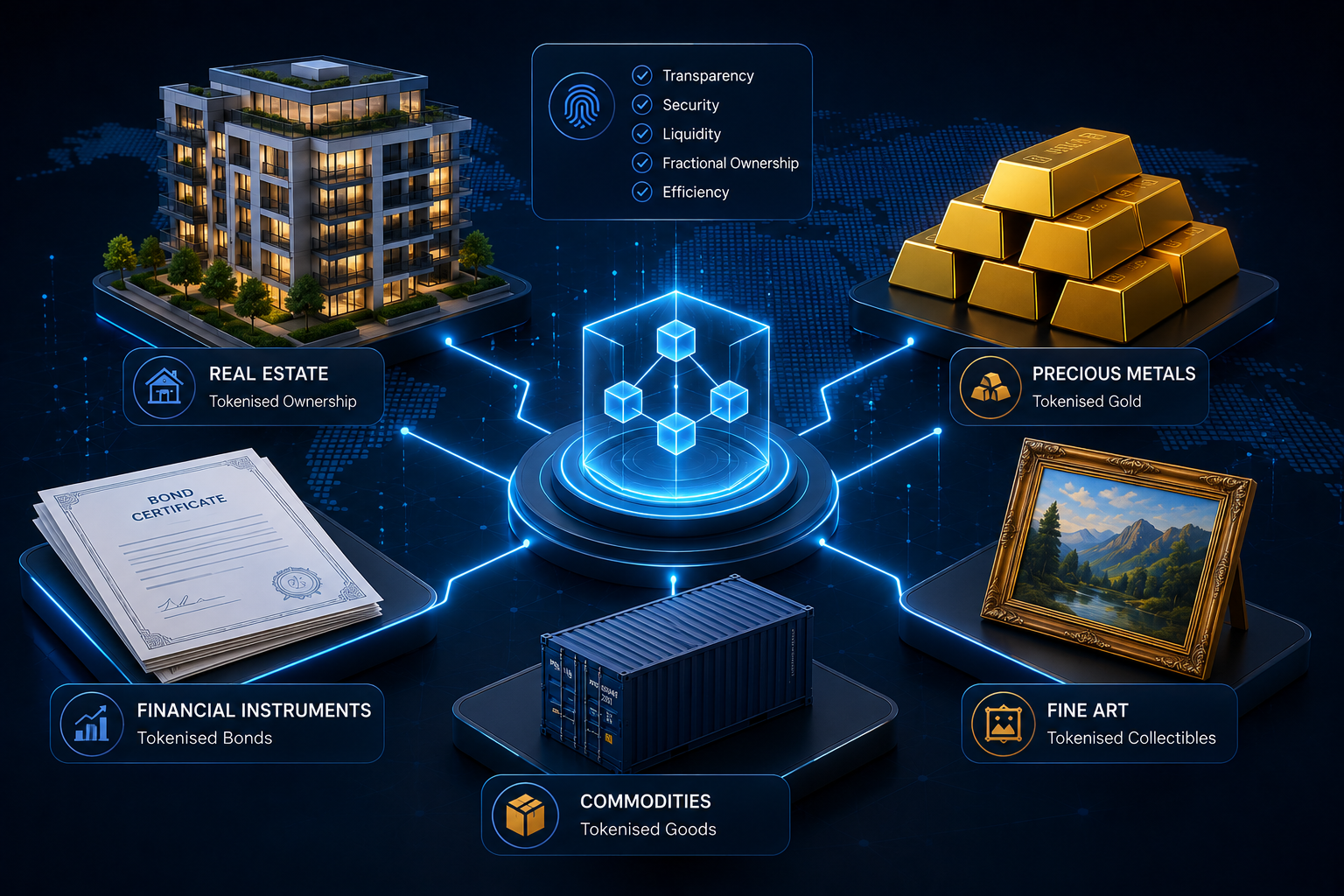

The tokenisation of real-world assets (RWAs) has emerged as a structural innovation in modern financial markets, enabling physical and traditional financial assets to be represented on blockchain infrastructure. This development is reshaping how ownership, transferability, and liquidity are managed across asset classes ranging from real estate and commodities to bonds and private equity.
For institutional participants and market professionals, RWA tokenisation represents a convergence of traditional finance and distributed ledger technology, with implications for capital efficiency, settlement speed, and market accessibility.
Real-world asset tokenisation is the process of converting ownership rights of physical or traditional financial assets into digital tokens recorded on a blockchain. Each token represents a fractional or whole claim on the underlying asset.
These tokens are programmable, transferable, and verifiable through distributed ledger systems, allowing assets that were previously illiquid or difficult to divide to become more accessible to a broader range of participants.
At its core, tokenisation functions as a bridge between off-chain value and on-chain representation, enabling integration between traditional financial systems and blockchain-based infrastructure.
The tokenisation process typically involves three primary components: the underlying asset, a legal framework, and a blockchain-based token issuance system.
The underlying asset can include real estate, government bonds, commodities, or private financial instruments. A legal structure defines ownership rights and ensures enforceability under applicable jurisdictional regulations. The blockchain layer then issues digital tokens that represent claims on the asset.
Smart contracts are used to define the rules governing issuance, transfer, and redemption of tokens. These contracts automate key processes such as dividend distribution, interest payments, and compliance checks.
This structure ensures that digital tokens remain directly linked to verifiable real-world value.
A wide range of asset classes are currently being integrated into tokenised frameworks. Real estate remains one of the most active segments due to its inherent illiquidity and high entry barriers. Tokenisation allows fractional ownership, enabling broader participation in property markets.
Fixed-income instruments such as bonds are also being tokenised to improve settlement efficiency and reduce intermediary dependency. In commodity markets, tokenisation enables more efficient tracking and transfer of physical goods such as gold and oil.
Private equity and venture capital funds are increasingly exploring tokenisation as a mechanism to enhance liquidity in traditionally long-term investment structures.
One of the primary advantages of RWA tokenisation is enhanced liquidity. By dividing large assets into smaller digital units, markets become more accessible and tradable.
Settlement efficiency is another key benefit. Blockchain-based systems reduce reliance on traditional clearing and settlement infrastructures, enabling near real-time transaction finality in some implementations.
Transparency is also improved through immutable transaction records, which enhance auditability and reduce information asymmetry among participants.
Operational efficiency increases as smart contracts automate administrative processes, reducing reliance on intermediaries and manual reconciliation.
Despite its advantages, RWA tokenisation operates within complex regulatory environments. Legal recognition of digital ownership varies across jurisdictions, and compliance with securities laws remains a critical requirement.
Regulatory frameworks typically focus on investor protection, asset custody, and anti-money laundering controls. Many tokenisation platforms operate within regulatory sandboxes to test compliance structures before scaling.
Legal enforceability of tokenised claims is a key factor in institutional adoption, as investors require assurance that digital representations are backed by legally binding agreements.
Institutional adoption of RWA tokenisation is gradually increasing as financial infrastructure matures. Banks, asset managers, and fintech platforms are exploring tokenised issuance models to improve capital efficiency and expand investor access.
Secondary markets for tokenised assets are also developing, allowing for improved price discovery and liquidity. However, market depth remains limited compared to traditional financial markets, indicating an early-stage adoption curve.
Interoperability between blockchain networks and traditional financial systems is a key focus area for infrastructure providers, as seamless integration is necessary for large-scale adoption.
Despite strong potential, several challenges remain in the widespread adoption of RWA tokenisation. Regulatory fragmentation across jurisdictions creates operational complexity for cross-border issuance.
Valuation transparency of underlying assets can also be difficult, particularly in private or illiquid markets. Additionally, technological standardization is still evolving, limiting interoperability between different tokenisation platforms.
Custody of underlying physical assets introduces additional risk layers that must be carefully managed to ensure token integrity.
The long-term trajectory of RWA tokenisation is closely linked to the evolution of digital financial infrastructure. As regulatory clarity improves and institutional participation increases, tokenisation is expected to expand across multiple asset classes.
Integration with decentralized finance protocols may further enhance liquidity and create hybrid financial systems that combine traditional asset backing with programmable financial instruments.
Over time, tokenisation is expected to become a foundational component of global capital markets, particularly in areas requiring fractional ownership and improved settlement efficiency.
The tokenisation of real-world assets represents a significant structural shift in financial market architecture. By enabling digital representation of physical and traditional assets, it enhances liquidity, efficiency, and accessibility across multiple asset classes.
As infrastructure matures and regulatory frameworks evolve, RWA tokenisation is positioned to play a central role in the convergence of traditional finance and blockchain-based systems.