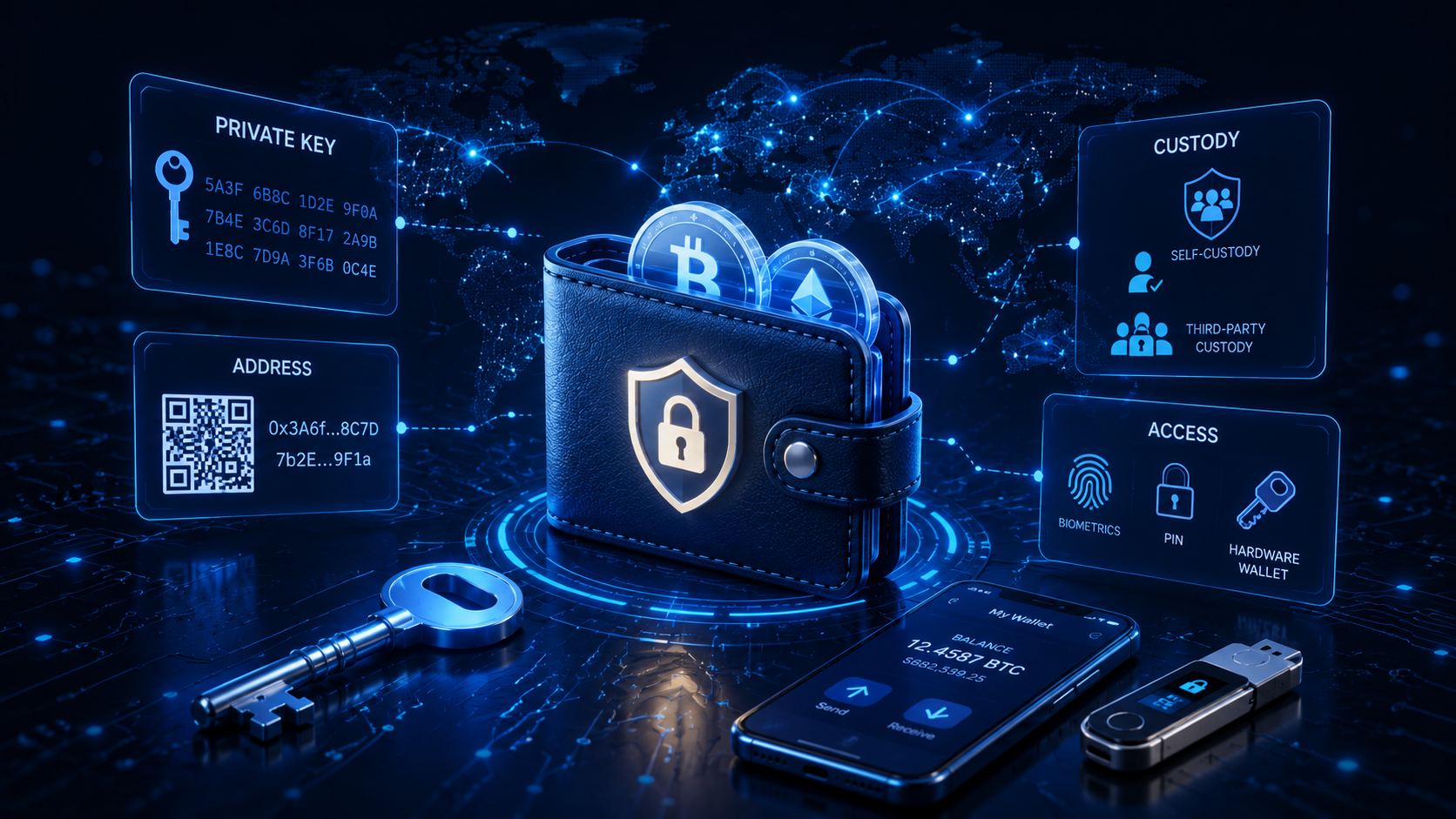

Digital wallets have become a foundational component of the modern digital financial system. As blockchain technology continues to expand across global markets, these wallets are no longer just tools for storing cryptocurrencies but have evolved into secure gateways for accessing decentralized financial networks.
For investors and professionals, understanding how digital wallets function is essential for navigating the digital asset economy. Concepts such as private keys, wallet addresses, custody structures, and access control define how ownership is established and secured in a blockchain environment. Unlike traditional banking systems, digital wallets operate in a decentralized framework where users must take greater responsibility for security and asset management.
A digital wallet is a software or hardware-based tool that allows users to store and manage cryptographic credentials required to access blockchain-based assets. Contrary to common belief, cryptocurrencies are not physically stored inside the wallet. Instead, the wallet stores the keys that provide access to assets recorded on a blockchain ledger.
Each wallet acts as an interface between the user and the blockchain network, enabling transactions such as sending, receiving, and verifying digital assets. The blockchain itself maintains the actual record of ownership, while the wallet ensures secure access to those records.
From an investment perspective, digital wallets serve as the operational layer that connects individuals and institutions to decentralized financial systems.
At the core of every digital wallet lies a pair of cryptographic keys: the public key and the private key. These keys work together to secure transactions and verify ownership.
The public key is derived from the private key and is used to generate a wallet address. It can be safely shared with others to receive funds without exposing sensitive information. In contrast, the private key is a confidential code that grants full control over the associated digital assets.
If the private key is compromised, the security of the entire wallet is at risk. This makes private key management one of the most critical aspects of digital asset security. Investors are often advised to store private keys in secure offline environments to reduce exposure to cyber threats.
The relationship between these two keys forms the foundation of blockchain security, ensuring that only authorized users can access and transfer funds.
A wallet address is a simplified representation of a public key that is used to receive digital assets. It functions similarly to a bank account number but is designed for blockchain transactions.
When a user wants to receive cryptocurrency, they share their wallet address with the sender. The transaction is then recorded on the blockchain, linking the transferred assets to that specific address.
Wallet addresses are generally safe to share publicly because they do not grant access to the funds themselves. However, they are essential in ensuring transparency and traceability within blockchain networks.
For investors, wallet addresses serve as the visible layer of participation in the digital asset ecosystem, while the underlying keys remain hidden and secure.
Digital wallets can be categorized based on how private keys are managed. The two primary types are custodial wallets and non-custodial wallets.
In a custodial wallet, a third-party service provider manages the private keys on behalf of the user. These services are commonly offered by cryptocurrency exchanges and fintech platforms. Custodial wallets are generally easier to use and offer recovery options in case of lost credentials, making them suitable for beginners.
However, they also introduce a dependency on the service provider. Users must trust that the platform will securely manage their assets and maintain operational integrity.
In contrast, non-custodial wallets give users full control over their private keys. This means the user has complete ownership and responsibility for their digital assets. While this model offers greater independence and security from third-party risks, it also places the burden of key management entirely on the user.
For professional investors, non-custodial wallets are often preferred due to the principle of self-sovereignty in blockchain systems.
Access to a digital wallet is protected through multiple layers of security mechanisms designed to prevent unauthorized entry. These typically include passwords, recovery phrases, and multi-factor authentication systems.
A recovery phrase, often consisting of 12 to 24 words, is generated when a wallet is created. This phrase acts as a backup key that can restore wallet access if the original device is lost or damaged. However, anyone who gains access to the recovery phrase can fully control the wallet, making its protection extremely important.
Security practices such as offline storage, hardware wallets, and encrypted backups are commonly used to safeguard digital assets. Hardware wallets in particular are considered highly secure because they store private keys in offline environments, significantly reducing exposure to online threats.
In addition, users must remain cautious of phishing attacks and fraudulent platforms that attempt to steal wallet credentials. As the digital asset ecosystem grows, security awareness has become just as important as investment strategy.
For investors, digital wallets are more than just storage tools. They represent direct access to decentralized financial markets and blockchain-based investment opportunities.
The ability to securely manage private keys allows investors to maintain full control over their assets without relying on traditional financial intermediaries. This level of control introduces both opportunity and responsibility, as users must ensure proper security practices are in place.
Digital wallets also enable participation in emerging financial sectors such as decentralized finance, tokenized assets, and cross-border digital payments. As institutional adoption increases, wallets are becoming essential infrastructure for global digital asset management.
Understanding how wallets function allows investors to make informed decisions about risk, custody models, and long-term asset protection strategies.
Digital wallets are a critical component of the blockchain ecosystem, enabling secure access to digital assets through cryptographic keys and decentralized infrastructure. By separating ownership from physical storage and relying on advanced encryption methods, wallets redefine how value is stored and transferred in the digital age.
For professionals and investors, mastering the concepts of keys, addresses, custody, and access is essential for navigating the evolving financial landscape. As blockchain technology continues to mature, digital wallets will remain at the center of innovation, security, and global financial transformation.